
Designing the Conditions for Growth: A Systems Approach to Leadership in Spring
Spring is often seen as a new beginning. Leaving behind the cold and dark winter days, our energy is renewed, opening space for a strategic reset - in life and work.
By “reset”, we mean beginning to do things differently after a period of rest, reflection, or change.
What is rarely said, though, is that spring does not equal growth and intentional change. It exposes where the system is and if there is fertile ground for healthy and strong growth. It is less a fresh start and more an outcome of the system’s condition.
And a system does not reset because the calendar changes, but because the conditions allow it.
So, what did you design for this season to grow?
Systems Thinking in leadership: why spring doesn’t automatically create growth
If we look at this transition through a systems lens, one insight stands out: behavior emerges from structure.
What we see on the surface – engagement, tension, clarity, burnout – is rarely random. It is shaped by how the system is designed. Patterns of growth or depletion are not created by the season itself, but by the underlying structure that has been shaping behavior over time.
Seasonal change does not automatically produce structural change. And without structural change, growth remains superficial.
This understanding is also central to Organizational & Relationship Systems Coaching (ORSC) – a systems coaching methodology from CRR Global - which views teams and organizations not as collections of individuals, but as living relationship systems with their own intelligence, patterns, and signals.
It is only when we shift from focusing on individuals to seeing the collective system that different possibilities begin to emerge.
Stocks in organizations: what has your team been accumulating?
According to Donella Meadows in Thinking in Systems, a stock is something that accumulates over time.
Some of the most influential stocks in leadership systems include:
Trust – the foundation of collaboration and decision-making
Psychological safety – the ability to speak openly without fear
Leadership credibility – the level of confidence people place in direction and decisions
Energy reserves – physical and cognitive capacity
Decision quality – clarity, alignment, and follow-through
Cultural norms – the shared, often unspoken rules that shape behavior
Like all accumulations, they change slowly, and they erode slowly as well.
In nature, stocks are the fertile soil, roots, and stored nutrients. So, spring blooms are not new events but rather visible expressions of accumulated stocks. Growth is a revelation of what’s been underneath.
Which leads to an important question: What has your system been accumulating over time?
Energy or exhaustion?
Clarity or confusion?
Trust or quiet tension?
Because if stocks are depleted, no amount of seasonal enthusiasm will produce sustainable growth.
Flows in organizations: what is feeding or draining your team?
If stocks are accumulations, flows are what feed or drain them: inflows and outflows.
In organizations, flows include: feedback conversations, decision-making, meetings, email volume, conflict expression or avoidance, periods of rest, hiring, and attrition.
Some flows function as inflows, building capacity:
Rest restores cognitive and emotional energy.
Clarity conversations reduce ambiguity before it compounds.
Constructive conflict strengthens trust when addressed directly.
Learning cycles integrate feedback instead of repeating patterns.
Other flows function as outflows, draining capacity.
Reactive decision-making replaces reflection with urgency.
Excessive meetings create coordination without alignment.
Unresolved tension consumes energy quietly.
Constant urgency escalates pressure without recalibration.
Winter may look like stillness, but beneath the surface, nature regulates flows: roots preserve energy, and the soil replenishes nutrients. Growth slows so that capacity can rebuild over time. Nothing is still.
The same applies to teams: Did your team have time to regulate its flows last winter? Or Q4 pressure simply carried into Q1?
If there was a continuous outflow of energy and insufficient inflow of restoration, stock depletion is inevitable. And you cannot bloom from depleted soil.
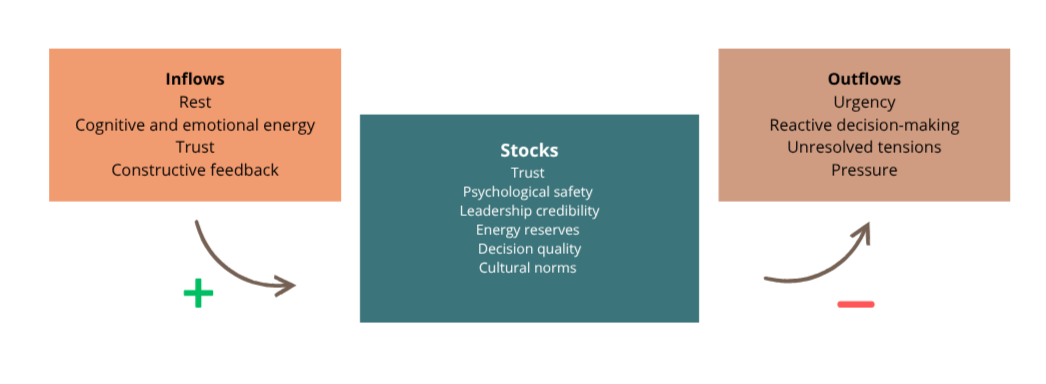
Image 1: Your system is shaped by stocks, flows, and feedback loops — not isolated actions.
Reinforcing vs. Balancing feedback loops in organizations
When we talk about feedback loops, we often focus on growth. But in systems thinking, not all loops amplify. Some stabilize. And both are essential.
Reinforcing loops: how growth compounds
Reinforcing loops are what amplify movement. They accelerate whatever direction the system is already heading. In spring, longer days increase light exposure, boosting photosynthesis and supporting further growth. Energy captures more energy. Momentum builds.
In organizations, reinforcing loops can be seen as the following example:
Clarity that strengthens decision quality; better decisions build trust; trust increases engagement; and engagement supports clearer execution.
When reinforcing loops are healthy, growth compounds.
But reinforcing loops are not inherently positive.
For instance, pressure can reinforce itself: urgency accelerates decisions; rushed decisions create rework; and rework increases pressure. The loop tightens and perpetuates exhaustion.
It is structure, not motivation, that determines whether reinforcing loops lead to vitality or depletion inside an organization.
Balancing loops: why limits protect performance
Alongside reinforcing loops, every healthy system also relies on balancing loops. These are the regulating or protecting mechanisms that prevent the system from collapsing.
In nature, a drop in resources slows down growth, and a drop in temperature slows down activity. Dormancy is not a weakness, but a stabilizing force.
Winter is largely a season of balancing feedback. It protects the system from overextension. It regulates consumption and restores equilibrium.
In organizations, balancing loops generate signals when the system approaches its limits. Fatigue, friction, tension, and even conflict are indicators that the system is reaching its capacity. They are not problems to suppress, but information to integrate.
For example, when the workload increases, energy gradually decreases. As energy declines, performance begins to drop. Reduced performance slows output, which naturally limits further expansion of workload (unless intervention pushes the system to override that slowdown).
This is how balancing loops regulate a system.
The challenge is that many organizations override these regulatory mechanisms. Fatigue is reframed as a lack of resilience. Conflict is labeled as negativity. Slowing down is interpreted as underperformance. Instead of adjusting the structure, leaders try to push through these signals.
When regulatory feedback is ignored, balancing loops are suppressed and reinforcing loops of pressure take over. Reactivity increases, reflection disappears, and teams prioritize meeting deadlines over maintaining quality.
Over time, this becomes an easy trap: the system begins to exhaust its own resources.
Spring does not automatically activate healthy reinforcing loops. It amplifies whatever structure is already in place.
If balancing loops were respected over winter — if limits were acknowledged, feedback integrated, capacity restored — then reinforcing loops in spring will compound vitality.
If balancing loops were ignored, spring will simply accelerate depletion.
And here is where the “fix the people” mindset often appears.
Many organizations treat regulation as an individual responsibility. Rest is limited to evenings, weekends and holidays, where most people are actually busy with their families (kids or parents) and life. Recovery is framed as something employees must manage by themselves.
And once working days resume, the expectation returns to maximum pace, constant responsiveness, and uninterrupted efficiency.
But human systems do not recharge overnight. We are not machines that reset to full capacity each morning.
In many organizations, however, recovery is treated as an individual responsibility rather than a structural one. Rest is expected to happen outside working hours — during evenings, weekends, or vacations — while the pace of work remains unchanged during the workday.
This creates an implicit trade-off for employees: either recover in their personal time, sacrificing family life and rest, or continue pushing through exhaustion while maintaining the appearance of energy and engagement at work.
Neither option restores the system.
Without structural adjustments — recalibrated expectations, moderated workload, deliberate recovery rhythms — the system remains extractive. Individuals may temporarily compensate, but compensation is not restoration.
It takes a systemic view for organizations to take co-responsibility for regulation. Capacity is not a solely personal trait; it is shaped by the structure within which people work.
Supporting restoration and sustainable rhythms is therefore not only a human consideration — it is also in the organization’s own interest. When systems protect recovery, they sustain the very resources they depend on: energy, clarity, creativity, and decision quality.
Regulation strengthens the system. Without it, performance eventually weakens as human capacity becomes depleted.
So, the question shifts from: How do we grow more this quarter?
To
Which loops are we strengthening and which ones are we overriding?
If you grow without limits or recovery, you’re not building strength; you’re accelerating depletion.
Not only of energy, but of human capacity.
When systems override regulation for too long, fatigue accumulates, engagement declines, and creativity narrows. And eventually, either people leave, or they are quietly replaced.
What often looks like “normal turnover” can be a structural pattern: depleted people exit, new people enter, and the cycle begins again. Fresh energy temporarily masks the underlying design. But the structure remains extractive.
And while it is normalized in many industries, it is not sustainable.
A system that depends on constant replacement rather than regeneration is not high-performing. It’s over-consuming its own resources.
Sustainable growth requires co-responsibility. Not just individuals managing their energy, but organizations designing conditions where restoration is structurally supported.
Otherwise, what we call “growth” is simply exploitation.
Reinforcing and balancing loops in organizations: a common performance pattern
In many organizations, Q4 and early Q1 function like reinforcing loops. Q4 demands more work to reach specific targets, and the team pushes harder. When results come in strongly, expectations rise even more. Success creates pressure to repeat or exceed it. And before anyone notices, the pace becomes the new normal.
At the same time, balancing signals begin to surface. Fatigue shows up in small ways, decisions take slightly longer, and conversations that require honesty are postponed because “now isn’t the right time.” These are not signs of weakness. They are natural signals that the system is reaching its limits.
If those signals are acknowledged during winter — if recovery is taken seriously and pressure is allowed to ease — the system steadies itself, and it regains its capacity. By the time Q2 arrives, the renewed energy has something solid to stand on.
But if those signals are dismissed and the push continues uninterrupted, spring does not introduce healthy growth.
When capacity declines, performance may begin to slow.
In many organizations, this slowdown is misread as a motivation problem rather than a structural one.
The response is often escalation: more initiatives, more visible activity, more innovation layered onto exhaustion.
From the outside, it can look dynamic — new programs, new technologies, new workshops. But when capacity is depleted, activity does not equal value. The work may look impressive while depth and quality quietly erode.
Over time, the strain becomes visible. Engagement declines. Turnover rises. Depleted people leave and are replaced by “fresh” hires who temporarily restore output. The structure remains unchanged, and the cycle repeats.
How much of your engagement and motivation budget is compensating for structural exhaustion that a slightly slower pace could have avoided in February
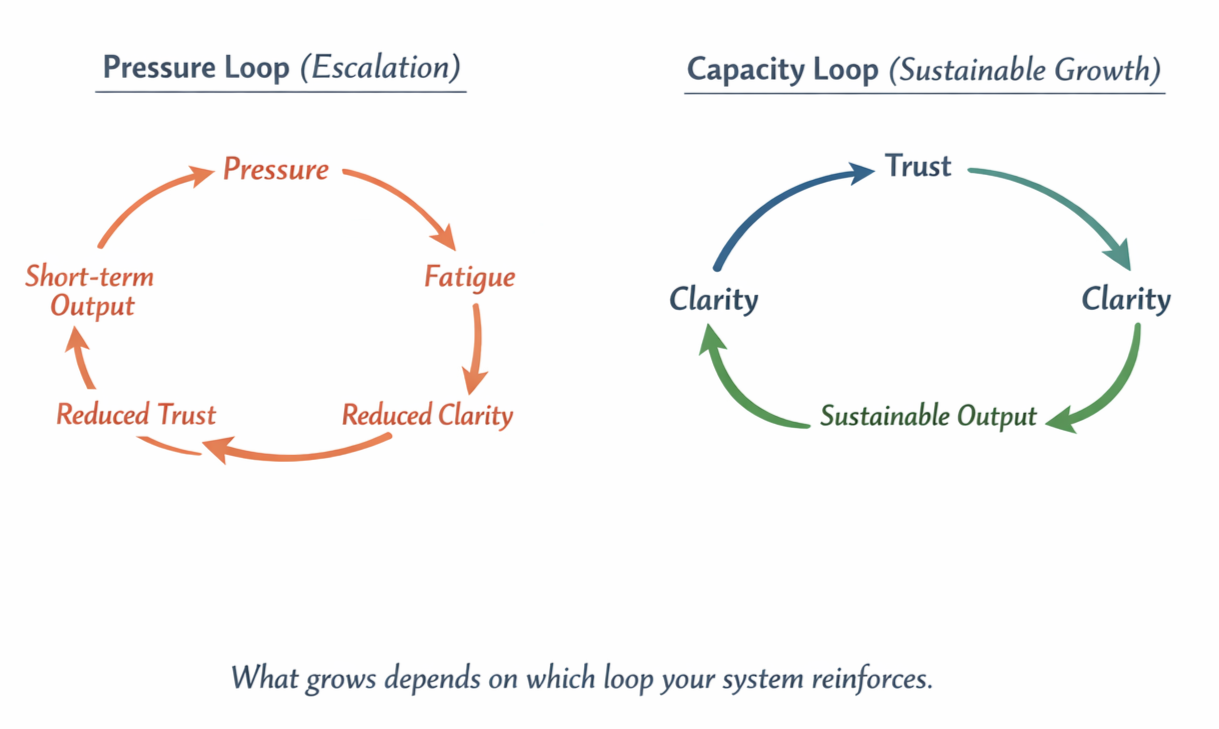
Image 2: The same system can drive growth or exhaustion. It depends on which loop you reinforce: pressure that accelerates depletion, or capacity that sustains performance.
If your team didn’t rest in winter: how to stabilize before you scale
If winter did not offer real regulation, then spring may feel strangely heavy.
You may notice a lack of enthusiasm, a greater need for clarity, small tensions resurfacing more quickly, and decisions taking longer, even though everyone is “trying harder.”
This is not a motivation issue, but rather an accumulated depletion. And Easter holiday won’t fix it.
When the balancing loops are ignored for too long, the system does not collapse immediately. It compensates. But compensation is not restoration.
When a system has been operating on compensation, adding new goals or accelerating growth does not create strength. It increases strain.
Are you having this uncomfortable realization — “this is us” ? Good, and it is not the end of the story. If winter did not allow capacity to rebuild, the question for spring is not how to accelerate, but how to restore capacity.
And by restoring capacity, we mean: reducing pressure before adding more, restoring energy before expecting expansion, and adjusting structure before demanding speed.
Only then can growth become sustainable.
Spring as an opportunity for recalibration: protecting capacity before growth
When soil has been overused, it does not collapse permanently. It responds. Sometimes slowly or imperfectly, but a reminder that systems, when allowed, can adapt too.
Nature is a beautiful example of a system that is flexible and resilient. And here are some options it offers us to learn from:
1. Do nothing at all. When no action is taken, the system enforces recovery
One option is to do nothing at all and to give up control entirely. At that point, recovery is no longer a leadership choice. The system will enforce whatever is needed to restore itself.
Capacity will decline, output will slow, and priorities will be dropped, whether consciously or not. Recovery will happen, but on the system’s terms. Not yours.
This is not a strategy. It is what happens when no decision is made.
Nature does this too. When soil becomes so depleted that even extra growth hormones no longer work, the land is left to rest. It may take a few years. Eventually, weeds appear first, and then other plants slowly begin to regrow.
It is not impressive growth, but it is regeneration.
In organizations, this is often the most counterintuitive leadership move — and sometimes the most necessary.
It may look like:
Not launching the new strategic initiative this quarter, even if it was planned
Holding headcount steady instead of pushing for rapid expansion
Allowing a temporary dip in output rather than forcing performance through exhaustion
Resisting the pressure to “show momentum” when the system is already overloaded.
This path requires discipline at the leadership level. Because the pressure will not come from the team — it will come from markets, boards, and internal expectations.
Yields won’t be immediate.
But this is how systems rebuild capacity instead of consuming what remains.
2. Take the ‘winter’ break now. Better late than never.
Ideally, regulation happens in winter. But early spring still allows recalibration.
If you didn’t trim, clear, or rebalance earlier, you can still do it now. Take the break now, slow down now. Better late than never.
Imagine it is your garden. The best time for trimming and weed removal is usually late fall, but early spring works as well. You may wait a tiny bit longer for your yields, but they will come equally strong.
In leadership terms, this is not about stopping everything — but about targeted structural correction:
Pausing one major initiative mid-rollout to resolve underlying misalignment
Reopening a decision that was rushed under Q4 pressure and is now creating downstream friction
Resetting performance expectations that quietly escalated beyond sustainable levels
Addressing a leadership team tension directly, before it spreads into execution.
This is often uncomfortable. It can feel like losing time.
But in reality, it prevents months of compounded inefficiency, rework, and silent resistance.
Like pruning, the impact is not immediate.
But the system reorganizes — and grows back cleaner, stronger, and more coherent.
3. (Re)introduce sustainable operating rhythms
Not every recalibration needs to be dramatic.
Organizations often lose this rhythm — and replace it with continuous pressure.
Reintroducing rhythm might look like:
Designing recovery into the operating model (e.g., no-meeting windows, post-delivery decompression time, realistic pacing between milestones)
Reducing ambient urgency (e.g., fewer “urgent” channels, clearer prioritization, limiting parallel initiatives)
Protecting deep work and decision quality (e.g., fewer but better-prepared meetings, clearer decision ownership)
Building reflection into execution cycles (e.g., short retrospectives that actually influence next steps, not just reporting)
Rebalancing workload and responsibility (e.g., redistributing decision load from bottleneck leaders, clarifying roles to reduce friction)
These are not dramatic moves.
But they shift the system from constant output mode to sustainable performance cycles.
Spring is a leverage point for change
Change of season is just a reminder, a moment of reflection, offered to us by nature. And spring invites us to reflect on the quality and readiness of our systems for growth.
So instead of asking: How do we accelerate performance this quarter?
You might ask:
Where is energy leaving the system faster than it is being restored?
What expectations quietly escalated over Q4 and never recalibrated?
Which signals of friction — hesitation, silence, turnover, fatigue — have we normalized as “the cost of performance”?
Where are we pushing harder instead of redesigning the conditions that produce results?
If Q2 succeeds, what must remain sustainable by Q3 - for people, not just numbers?
Because systems rarely fail from lack of effort. They fail when pressure grows faster than capacity.
Leadership, at its core, is not only about setting direction.
So remember: Spring does not create growth. It reveals what the system has been preparing to become.
And leadership determines what that system prepares for next.